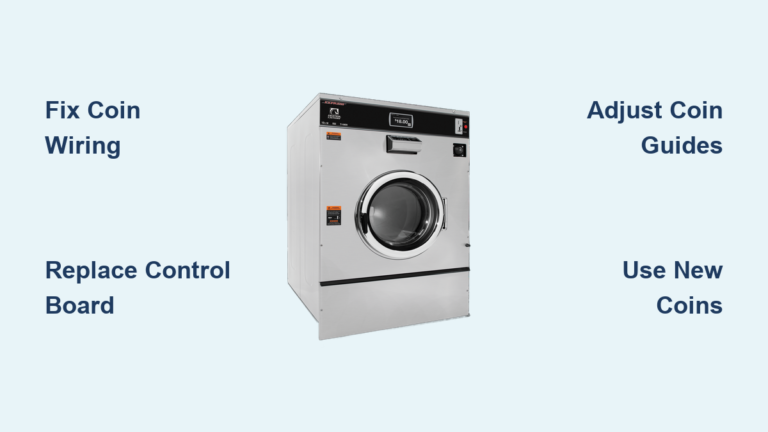

Roper Washing Machine Repair Guide
Is your Roper washing machine failing to spin, leaking water, or making loud banging noises? You’re not alone. Thousands of homeowners face similar issues with their Roper washers, many of which can be fixed in under an hour with basic tools and a $15 part. Whether your machine won’t drain, won’t start, or is walking across the floor during spin, this guide gives you exact diagnostic steps, model-specific fixes, and proven repair procedures directly from technical manuals and real-world service data.
You will learn how to pinpoint the problem using visual clues, error codes, and simple tests, then apply the right fix with confidence. From replacing a $4 motor coupler to diagnosing an F7E1 error code, every solution here is verified, cost-effective, and designed for DIY success. Let us get your washer running like new without paying for an expensive service call.
Diagnose No-Spin Issues Fast
When your Roper washer fills and agitates but won’t spin, one component is likely to blame: the lid switch. This small part prevents operation when the lid is open, and it fails frequently. But do not jump to conclusions. Use these steps to confirm the cause before disassembling anything.
Test the Lid Switch First
The lid switch is responsible for 60% of no-spin repairs. If your washer stops before the spin cycle, start here:
- Listen for a click when closing the lid. No audible snap? The switch may be dead.
- Unplug the washer and wait 5 minutes for power to discharge.
- Remove the console by unscrewing two Phillips-head screws at the front.
- Tilt the console back and disconnect the wiring harness.
- Locate the lid switch, usually near the lid strike.
- Use a multimeter to test continuity. Set to ohms or continuity mode, press the switch plunger, and there should be a closed circuit with a beep or 0Ω reading. No continuity means replace the switch.
Pro Tip: Always reconnect the grounding wire after reassembly. Skipping this risks electrical shock.
Cost: $12 to $42
Time: Under 30 minutes
Difficulty: Easy
Replace the Motor Coupler (ER285753)

If your washer agitates but won’t spin and the motor hums, your motor drive coupler has likely failed. This is the most common failure in Roper Direct Drive models, identifiable by black plastic or rubber fragments under the machine.
Confirm Coupler Failure
The motor coupler is a sacrificial component designed to fail first to protect the motor and transmission. Watch for these symptoms:
- Motor runs during spin but tub does not move
- Black or white debris beneath the washer
- Model range: 1990 to 2005 Roper, Whirlpool, Kenmore, and Amana top-loaders
Remove Cabinet and Access Motor
- Unplug the washer.
- Remove two screws securing the console.
- Tilt console back and disconnect modular connector.
- Use a flat-head screwdriver to release brass clips on both sides.
- Lift cabinet straight up and set aside.
- Open lid to 45 degrees, lift forward, and remove.
Now access the motor and pump:
- Disconnect motor wiring harness.
- Release water pump retaining clips with a flat-head screwdriver.
- Slide pump off motor shaft.
- Remove quarter-inch and three-eighths-inch motor mounting screws.
- Release bottom motor clip first, then top. Support motor as it drops slightly.
Install New Coupler (Part ER285753)
- Remove old coupler. Pry off transmission-side fork with flat-head screwdriver. Pull out rubber grommet and broken plastic halves.
- Install new coupler. Push short end onto motor shaft, long end onto transmission shaft. Use a socket with extension to tap both ends flush, applying even pressure. Align rubber grommet: 12 o’clock on motor side, 6 o’clock on transmission. Insert plastic forks into matching holes and ensure they seat fully.
Reassemble and Test
- Reattach motor. Reinstall bottom clip, then top, pressing until you hear a click. Secure with screws.
- Reconnect water pump. Align keyed shaft with motor. Slide on and snap clips into place.
- Rebuild cabinet. Slide cabinet up into position. Reinstall brass clips. Reconnect wiring and secure console.
- Level the washer by lifting and setting down to activate self-leveling legs.
Final test: Plug in, select Spin cycle, and verify smooth operation.
Cost: $4 to $34
Time: About 30 minutes with experience
Difficulty: Moderate
Diagnose and Replace Worn Clutch
If the inner tub spins freely when you turn it by hand, even when unplugged, the clutch is worn out. This causes weak or no spin, leaving clothes soaking wet.
Perform Hand-Spin Test
- Unplug washer and remove lid.
- Rotate inner tub clockwise.
- Normal feel is slight resistance, like stirring thick batter.
- Failed clutch: tub spins easily with minimal effort.
This test is a reliable indicator of clutch failure in Direct Drive models.
Replace Clutch Kit
- Remove agitator, usually unscrewing from center with a three-eighths-inch socket.
- Disconnect pump and motor as shown above.
- Remove transmission to access clutch.
- Slide old clutch off shaft.
- Install new clutch using a brake cam driver tool.
- Reassemble in reverse order.
Assistant Recommended: Yes, tilting the washer back makes access easier.
Cost: $19 to $68
Time: 1 to 2 hours
Difficulty: Moderate
Fix F7E1 Error and Shift Actuator Failure

Newer Roper models with six status lights use a shift actuator to engage spin mode. When it fails, you will see blinking lid-lock light, washer stuck in sensing mode, or error code F7E1. This is common in post-2005 modular vertical models.
Replace the Shift Actuator
- Tilt washer backward for under-access.
- Remove pulley cover and drive belt.
- Unscrew actuator from gear case.
- Disconnect electrical connector.
- Install new actuator, cost $49 to $52.
- Reconnect wiring and reassemble.
Run Calibration Cycle
This critical step syncs the system after replacement. Unplug washer for 1 minute, plug in, close lid, press Spin and Temperature buttons simultaneously for 3 seconds, and wait for machine to cycle through motions for 2 to 3 minutes. No calibration means continued malfunction.
Success Rate: High when procedure is followed.
Stop Vibration and Walking

If your washer shakes violently or walks across the floor, suspension rods are likely worn. These support the tub and dampen spin vibrations.
Inspect Suspension System
- Open cabinet as shown above.
- Check all four rods under the tub.
- Look for sagging or broken rods, rust or corrosion, or tub leaning backward.
Even if only one rod looks bad, replace all four.
Replace All Four Suspension Rods
- Lift top panel.
- Support tub if needed.
- Remove old rods.
- Install new set, cost $70 to $73 for full set.
- Ensure even tension and alignment.
Why All Four? Rods wear together. Replacing only one causes imbalance and repeat failure.
Time: 45 minutes
Difficulty: Easy to Moderate
Fix Poor Agitation with Agitator Dogs
If the top of the agitator spins but the bottom does not, your agitator dogs are worn. This leads to poor cleaning, especially in model RAS6233KQ1.
Test Agitator Dogs
- Remove top cap, which pops off easily.
- Turn top agitator clockwise. Bottom should stay still. If bottom rotates too, dogs are bad.
- Turn counter-clockwise. Some movement is normal.
Replace Dogs (Part 8004)
- Pull out old teardrop-shaped plastic dogs.
- Insert new ones, manufacturer Subco part 8004.
- Reinstall center bolt with three-eighths-inch socket.
- Snap cap back on.
Cost: $5 to $15
Time: Under 20 minutes
Difficulty: Easy
Fix Drainage Problems
Water left in the tub after cycle? You likely have a drain issue. Common causes include clogged drain hose, blocked pump filter, failed drain pump, or faulty lid switch.
Clear Drain Hose and Pump
- Unplug washer.
- Place towels and bucket under pump.
- Remove access panel, usually front or back.
- Disconnect hoses from pump.
- Flush out debris like coins, socks, and lint.
- Reconnect and test.
If no blockage, test pump with multimeter for continuity. No reading means replace pump, cost $30 to $60.
Repair Cost vs. Replacement
Before calling a technician or buying new, compare costs:
| Repair Job | DIY Cost | Pro Cost | New Washer Cost |
|---|---|---|---|
| Lid Switch | $12–$42 | $150–$300 | Up to $600 |
| Motor Coupler | $4–$34 | $150–$300 | Up to $600 |
| Clutch | $19–$68 | $150–$300 | Up to $600 |
| Shift Actuator | $49–$52 | $150–$300 | Up to $600 |
| Suspension Rods | $70–$73 | $150–$300 | Up to $600 |
| Agitator Dogs | $5–$15 | $150–$300 | Up to $600 |
Rule of Thumb: Repair if machine is under 10 years old and repair cost is less than half of a new unit.
Essential Tools and Parts
Must-Have Tools
- Phillips and flat-head screwdrivers
- Socket set including quarter-inch and three-eighths-inch
- Extension and small socket for coupler tapping
- Multimeter
- Brake cam driver for clutch
- Pliers for hose clamps
- Gloves and safety glasses
Critical Replacement Parts
- Motor coupler: ER285753
- Lid switch: Model-specific, $12 to $42
- Shift actuator: $49 to $52
- Suspension rods four-pack: $70 to $73
- Agitator dogs: Part 8004
- Water inlet valve: $25 to $50
- Drain pump: $30 to $60
Always confirm model and serial number before ordering parts.
When to Call a Pro: Sears Home Services
If DIY is not your style, Sears Home Services offers expert Roper washer repairs with over 1,500 technicians nationwide averaging 10 years of experience. Brands serviced include Roper, Whirlpool, Maytag, Kenmore, LG, Samsung, and more. Same-day or next-day service is available, and the diagnostic fee applies to repair cost. Warranty options and maintenance plans are also available.
Common Repairs They Handle
- Vibration and noise issues
- Leaks and drainage problems
- Control board failure
- Gear case replacement costing $300 or more
- Electronic diagnostics
Repair vs. Replace?
- Repair if under 10 years old
- Replace if repair exceeds half the cost of new
- Discounts available if replacement is needed
Final Diagnostic Checklist
Use this sequence to quickly identify and fix your Roper washer:
- No Spin? Test lid switch, which fixes 60% of cases.
- Motor Humming? Inspect for coupler debris, part ER285753.
- Tub Spins Freely by Hand? Replace clutch.
- F7E1 Error? Replace shift actuator and run calibration.
- Shaking or Walking? Replace all four suspension rods.
- Poor Cleaning? Replace agitator dogs, part 8004.
- Won’t Drain? Check pump, hose, and lid switch.
- Leaking Water? Inspect pump seals, hoses, and tub seal.
- Won’t Start? Test power, fuse, and control board.
- Overfilling? Replace pressure switch or inlet valve.
Frequently Asked Questions About Roper Washing Machine Repair
How do I know if my Roper washing machine needs a new motor coupler?
If your washer agitates normally but the tub won’t spin and you see black or white debris under the machine, the motor coupler has likely failed. You may also hear the motor humming during what should be the spin cycle.
Can I repair my Roper washer myself, or do I need a professional?
Most Roper washer repairs are DIY-friendly with basic tools. Simple fixes like lid switch replacement, agitator dogs, and motor coupler replacement can save you $150 to $300 in service calls. However, gear case replacement or electronic control board issues typically require professional service.
What is the most common problem with Roper washing machines?
The most common failure is the motor coupler, especially in Direct Drive models from 1990 to 2005. This part is designed to fail first to protect the motor and transmission, and it costs only $4 to $34 to replace.
How much does it cost to repair a Roper washing machine?
DIY repairs range from $4 for a motor coupler to $73 for a full suspension rod set. Professional service calls typically cost $150 to $300, not including parts. A new washer costs up to $600.
Why does my Roper washer keep stopping mid-cycle?
Newer models with six status lights may display error code F7E1, indicating a failed shift actuator. This requires replacement of the actuator and running a calibration cycle to sync the system.
How long do Roper washing machines last?
With proper maintenance and timely repairs, a Roper washer can provide reliable service for 20 years or more. The Direct Drive series is particularly known for durability and repairability.
Key Takeaways for Fixing Your Roper Washing Machine
Roper washing machines, particularly the Direct Drive series, are built to last 20 or more years with proper care. Most failures stem from simple, inexpensive parts that you can replace yourself. The motor coupler, part ER285753, is the most common failure point in older models and is easily replaced with basic tools. The lid switch is the number one cause of no-spin issues, so test it first before ordering expensive parts. Shift actuator failures are prevalent in newer modular units, but remember that calibration after replacement is mandatory. Suspension rods must be replaced as a complete set of four to prevent imbalance. Agitator dogs, part 8004, are a frequent cause of poor cleaning and are simple to fix in under 20 minutes.
By following this guide, you will save hundreds in service fees, extend your washer’s life, and gain the confidence to handle future issues. Keep this page handy because the next fix might take less time than your next load of laundry.