Washing Machine Won’t Agitate: Quick Fix Tips
Your washing machine fills with water, drains, and even spins, but the clothes come out just as dirty as they went in. If your washer will not agitate, you are not alone. This frustrating issue affects top-loading models from Whirlpool, Maytag, Kenmore, and Amana, leaving users confused about what went wrong.
The good news? Most causes are DIY-friendly, cost under $30, and take less than an hour to fix. This guide walks you through every possible cause, how to test each component, and exactly what to do to restore full agitation.
Confirm the Problem Is Real
Before disassembling anything, verify the issue is not caused by settings or load problems.
Check Your Cycle Selection
Some wash cycles use minimal or pulsating agitation that can look like nothing is happening. Delicate, Rinse Only, and Soak cycles often appear inactive. Select a Normal or Heavy Duty cycle and wait at least 10 minutes after starting. Many machines delay agitation until water fills to the correct level.
Test With a Balanced Load
An overloaded or tangled drum may prevent proper agitation. Remove half the clothes and restart the cycle. If agitation returns, the issue was load-related, not mechanical.
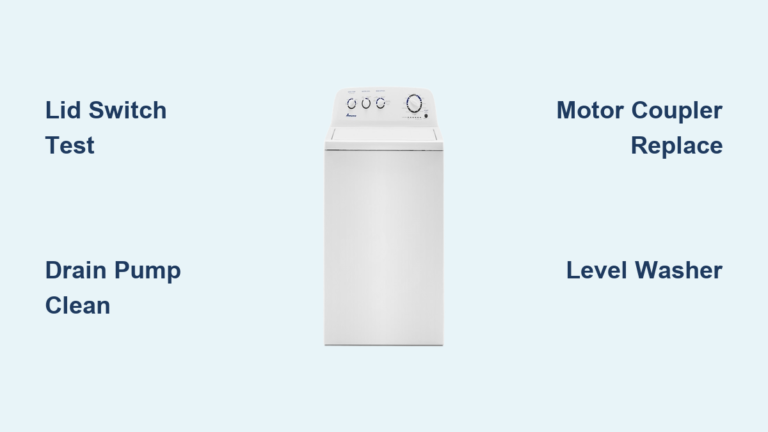
Lid Switch Failure: Top Cause
A faulty lid switch is one of the most common reasons a washer will not agitate, even when everything else seems fine.
How Lid Switches Stop Agitation
This safety feature prevents the washer from running when the lid is open. If the switch fails, the control board thinks the lid is open and blocks agitation. The tub may still spin, but the wash cycle halts.
Test for a Bad Lid Switch
Close the lid and listen for a click. If the click is missing, the switch is not engaging. Use a multimeter to test for continuity. No continuity means the switch is bad. Inspect the plastic plunger or strike on the lid for broken tabs or misalignment.
Replace the Lid Switch
Unplug the washer. Remove the console or cabinet to access the switch. Disconnect the wiring and remove the mounting screws. Install the new switch, reconnect the wires, and reassemble. Test with a normal cycle.
Pro Tip: Lid switch repairs fix about 30% of no-agitation cases and cost between $15 and $25.
Worn Agitator Dogs: Silent Culprit

If the motor runs and the drum spins but the agitator does not move, worn agitator dogs are likely the culprit. This is especially common in Whirlpool, Kenmore, and Maytag top-loaders.
What Are Agitator Dogs
These small plastic teeth sit inside the base of the upper agitator. They lock the upper section to the drive shaft during agitation. When worn or broken, the shaft spins but the agitator stays still.
Signs of Failed Agitator Dogs
The upper agitator turns freely by hand. The lower tub may still spin during drain. Clothes are not cleaned despite a full cycle. You might hear slipping or skipping sounds during operation.
Replace Agitator Dogs in 20 Minutes
Pry off the top cap with a flat-head screwdriver. Some models have a plastic retainer that you remove with pliers. Use a 7/16-inch socket or wrench to remove the center nut. Hold the agitator base from below to prevent turning.
Pull the upper agitator straight up and flip it over. Check the four plastic dogs. If the teeth are smooth, cracked, or missing, replace them. Clean the dog chamber and insert new dogs with teeth facing the spindle. This orientation is critical for engagement.
Reassemble by lowering the agitator, adding the rubber washer, and tightening the nut a quarter turn past hand-tight. Snap the cap back on.
User Verified: A $12 repair restores full function on machines over 10 years old.
Avoid This Mistake: Installing dogs backward causes immediate failure. Always check the orientation before installation.
Broken Drive Belt: No Motion, Loud Noise
If your washer hums but does nothing, a broken or slipped drive belt could be the issue. This is common in belt-driven models.
Symptoms of Belt Failure
The motor runs, but there is no agitation or spin. You might hear squealing or smell burning rubber. Look for visible belt debris under the machine.
Inspect the Belt
Unplug the washer and tilt it backward. Remove the back or front panel. Look for the rubber belt connecting the motor to the transmission pulley. Check for breaks or cracks, a glazed shiny surface, or slack. The belt should allow only ¼ to ½ inch deflection.
Replace the Drive Belt
Remove the old belt from both pulleys. Route the new belt the same way as the old one. Note the path before removal. Rotate the motor mount to tension the belt. Reassemble and test.
Time Estimate: 30 to 45 minutes. Part Cost: $15 to $20.
Failed Motor Coupler: Common in Older Models
Whirlpool, Amana, and Kenmore washers from the 1990s to 2000s use a motor coupler. This small plastic and rubber piece connects the motor to the transmission.
Why Couplers Fail
They are designed to break during overloads to protect the motor. After 7 to 10 years, rubber degrades and plastic hubs crack.
Symptoms
The motor hums but there is no agitation or spin. You might find pieces of black rubber inside the cabinet. There is no movement despite power being on.
Replace the Motor Coupler
Unplug and tilt the washer. Remove the cabinet and access the base. Locate the three-piece coupler between motor and transmission. Remove the mounting bolts and pull off the old pieces. Press the new coupler onto both motor and transmission shafts. Reassemble carefully.
Pro Tip: Ensure both shafts are aligned during reinstallation. Misalignment causes premature failure.
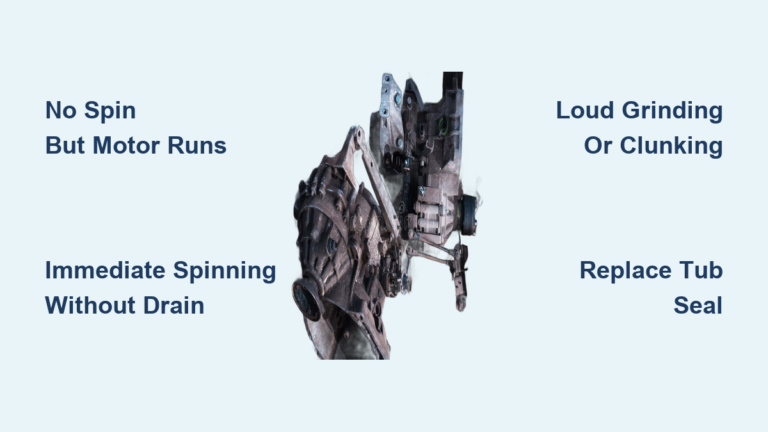
Mode Shifter Failure: Maytag and Whirlpool Issue
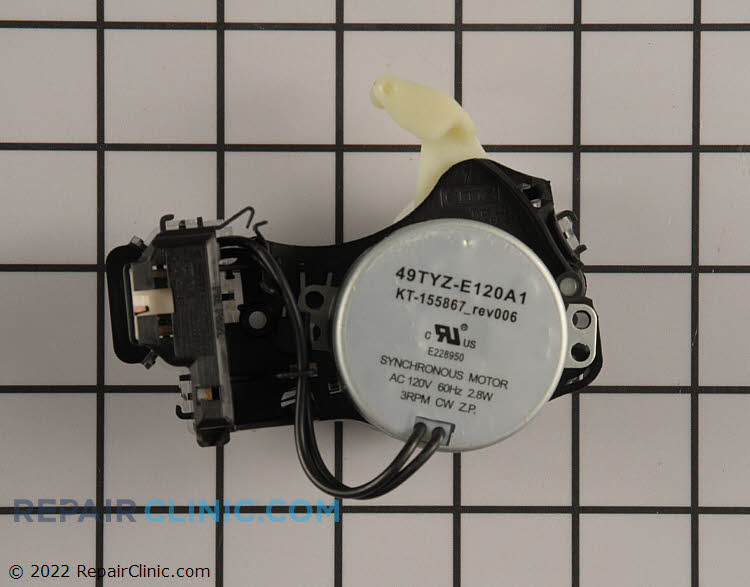
In modern belt-driven models, the mode shifter controls whether the transmission agitates or spins. If it fails, the washer fills but will not agitate, even if spinning works.
How to Diagnose a Bad Shifter
Tilt the washer backward. Find the actuator near the transmission, held by two green screws. Check the shifting arm. If it wobbles or moves freely, the internal gear is broken.
Replace and Recalibrate the Mode Shifter
Unplug the washer and disconnect hoses. Remove the belt cover and unplug the shifter connector. Take out the two green screws. One may be hidden under wiring.
Install the new shifter by aligning the arm with the clutch hook. Push the clutch down if needed. Seat the alignment pegs into the housing. Secure with screws and reconnect the plug.
Recalibrate the Shifter
Enter Factory Diagnostics Mode by pressing 1, 2, 3, 1, 2, 3 on the cycle buttons. When “Factory Diagnostics” appears, press Delay Start three times. Press Extra Rinse to start calibration. Press Delay Start to run the DLSM cycle. After completion, press Deep Fill to exit.
Success Rate: 90% of Maytag washers are restored to full function after this fix.
Part Note: Use your model number to find the correct shifter. Kits are model-specific.
Stator or Rotor Failure: Direct-Drive Models

LG, Samsung, and some GE washers use direct-drive systems with no belts or couplers. A stator and rotor create magnetic motion. If either fails, agitation stops.
Signs of Stator Failure
You hear humming with no movement. There is a burning smell or smoke. The washer will not agitate or spin. Error codes appear on the digital display.
Test the Stator
Use a multimeter to check resistance between terminals. It should read 3 to 6 ohms. Test for continuity to chassis. It should be infinite, meaning no short. If either test fails, replace the stator.
Replace Stator and Rotor
Remove the cabinet and tilt the washer. Disconnect the stator wires. Remove the mounting bolts and pull out the stator. Inspect the rotor for cracked magnets. Install a new stator and rotor kit together.
Critical Warning: A smoking stator must be replaced immediately. There is a fire risk.
Prevention Tip: Check for leaks. Water damage is a leading cause of stator failure.
Drive Motor Problems: Last Check
If all else checks out, the motor itself may be dead.
Symptoms
There is no sound and no movement. The motor hums but the shaft does not turn. You smell burning.
Test the Motor
Manually rotate the shaft with power off. It should spin freely. Use a multimeter to test windings for continuity. Check for voltage from the control board during agitation.
Replace the Drive Motor
Match the exact model number. Transfer mounting brackets if needed. Reconnect wires carefully.
Difficulty: High. This repair requires full base access and electrical knowledge.
Control Board Malfunction: Rare but Possible
When no components are visibly damaged, the control board may not be sending power to the motor.
Signs of Board Failure
The washer fills but does nothing. There is no response to button presses. The cycle stops at the same point every time. You see burn marks or bulging capacitors on the board.
Diagnose the Board
First rule out lid switch, belt, and coupler issues. Use a multimeter to test output voltage to the motor during agitation. If there is no voltage and inputs are good, the board is likely faulty.
Replace the Control Board
Unplug the washer. Access the console or rear panel. Remove and replace the board. Reconnect all harnesses. Some models require a reset or recalibration.
Note: Boards are expensive, costing $80 to $120, and should be a last resort.
Quick Diagnostic Decision Tree
Use this flow to find the cause fast.
Does the washer fill but not agitate? Continue if yes. Is the lid fully closed? Test the lid switch. Any motor sound? No sound means check lid switch, control board, or power. Humming means check belt, coupler, stator, or load. Does it spin? Yes means the problem is agitation-specific. Check agitator dogs or mode shifter. No means check belt, coupler, motor, or stator. Does the agitator spin freely by hand? Replace agitator dogs or drive block. Does the shifter arm wobble? Replace and recalibrate the mode shifter.
Essential Tools and Parts
You will need a flat-head screwdriver, a 7/16-inch socket or wrench, pliers, a multimeter, and towels for water.
Common replacement parts include agitator dogs at $10 to $20, lid switches at $15 to $25, drive belts at $15 to $20, motor couplers at $20 to $25, mode shifters at $50 to $80, and stator or rotor kits at $100 to $150.
Tip: Enter your full model number, found inside the lid or on the back panel, at Repair Clinic or Appliance Parts Pros for exact-fit parts.
Post-Repair Testing
After any fix, plug in the washer and select a Normal cycle. Watch for consistent back-and-forth agitation, no unusual noises, and no leaks around the agitator base.
If the agitator still does not move, double-check agitator dog orientation, lid switch connection, and mode shifter calibration.
Prevent Future Agitation Failures
Extend your washer’s life with these habits.
Avoid overloading. Excess weight wears out dogs and couplers. Do not wash heavy rugs or shoes frequently. Clean the agitator cap and base every 3 months. Use HE detergent only. Excess suds confuse sensors. Run a monthly clean cycle with vinegar or washing machine cleaner. Inspect belts and hoses annually.
When to Call a Pro
Seek professional help if you smell burning or see smoke. The motor or transmission needs replacement. You have replaced multiple parts with no fix. The washer is under warranty. You are uncomfortable with electrical testing.
Technician Insight: If only agitation fails, it is likely the mode shifter or agitator dogs. If both agitation and spin fail, suspect motor, belt, or stator issues.
Final Thoughts on Fixing Your Washing Machine
Most washing machine agitation problems come down to a handful of components. Start with the simplest, cheapest fixes first: the lid switch, agitator dogs, and drive belt. These three items account for the majority of no-agitation cases and can be repaired in under an hour with basic tools.
More complex repairs like mode shifter recalibration, stator replacement, and control board diagnosis come next. These require more time, higher part costs, and greater technical skill. Always test each component systematically before replacing expensive parts.
Your washing machine does not have to stay broken. With the right diagnosis and a few basic tools, you can restore full agitation and get back to clean clothes fast.
Frequently Asked Questions About Washing Machine Agitation Problems
Why does my washing machine fill with water but not agitate?
This usually indicates a problem with the lid switch, agitator dogs, or mode shifter. The motor is running, but the mechanism that creates the back-and-forth motion is not engaging. Check these components in order of likelihood.
Can I replace agitator dogs myself?
Yes. Agitator dog replacement is one of the easiest DIY repairs. It takes about 20 minutes and costs $10 to $20 for the part. Simply remove the agitator cap, unscrew the center nut, and swap the worn dogs for new ones.
How do I know if the mode shifter is bad?
Flip the washer onto its back and locate the mode shifter near the transmission. If the shifting arm wobbles freely or moves without resistance, the internal gear is broken. The washer may still spin but will not agitate.
Is it worth repairing a washing machine that will not agitate?
Yes. Most agitation repairs cost under $30 and take less than an hour. Even mode shifter replacement runs $50 to $80. This is far cheaper than buying a new washer, which typically costs $400 to $800.
What if my washer neither agitates nor spins?
This points to a broader drive system problem. Check the drive belt, motor coupler, or stator. These components affect both agitation and spin functions. If the motor hums but nothing moves, the coupler or belt is likely the culprit.