DeWalt Pressure Washer Troubleshooting Guide
If your Dewalt pressure washer won’t start or isn’t building pressure, you’re not alone. These issues affect hundreds of users each year, especially after storage or with new units out of the box. The good news? Most problems have simple, DIY fixes that take minutes to hours, not days. Whether you own a DXPW3025, DXPW3625, DP3400, or another Dewalt model, this guide targets the most common failures using real-world repair data and proven solutions. You’ll learn how to diagnose no-pressure conditions, revive a dead engine, and prevent future breakdowns, all without costly service calls.
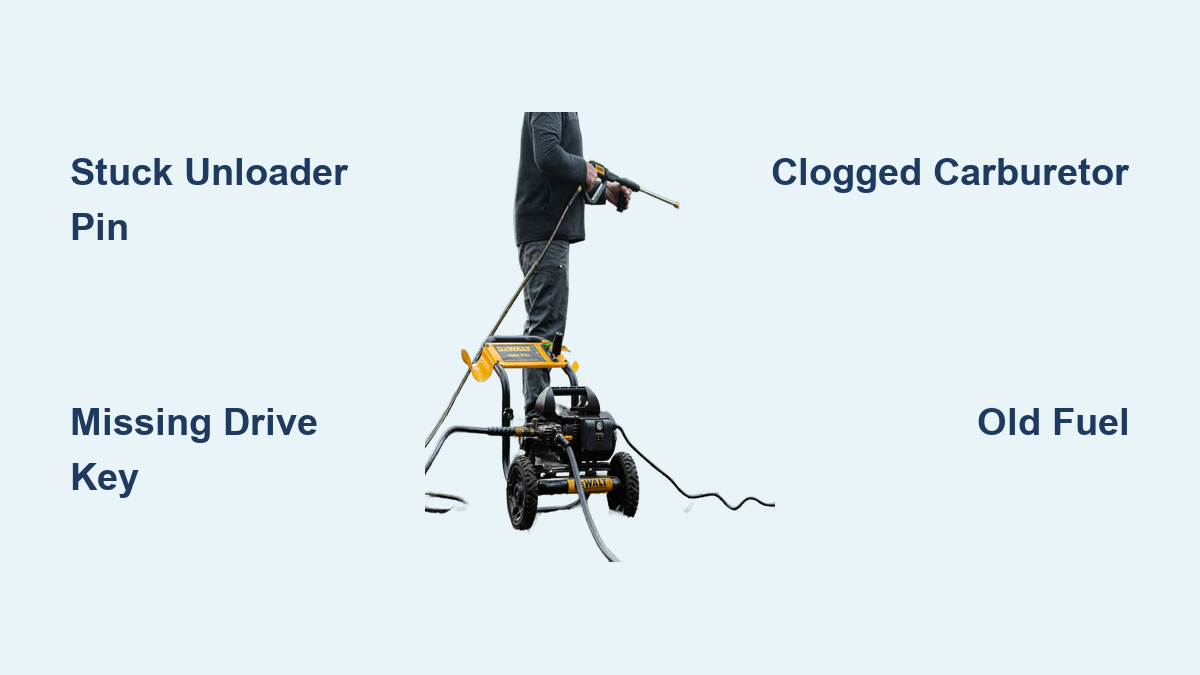
We focus on two major symptom groups: no pressure despite a running engine, and engine won’t start. Each has a handful of root causes, but one issue alone, a stuck unloader valve pin, accounts for up to 95% of no-pressure cases on 3000 PSI models. Similarly, carburetor clogs from old fuel are the top reason engines fail to start after sitting. By following the steps here, you’ll save time, money, and frustration.
Diagnose No Pressure First
When your Dewalt pressure washer runs but delivers only a trickle, the engine is working, but the pump isn’t pressurizing water. Start here before tearing into complex repairs.
Check the Drain Valve
Some models feature a manual drain valve at the base of the pump. If left open, it bypasses all pressure.
- Locate the valve, often a knob or lever on the pump housing
- Turn it fully closed
- Re-test the unit with water supply on and trigger depressed
Note: Not all models have an external drain valve. If you don’t see one, move to the next step.
Test Water Flow Without Hose
This isolates whether the blockage is in the pump or downstream components.
- Shut off engine and disconnect high-pressure hose from pump outlet
- Turn on garden hose supply with motor off
- Observe flow from the pump’s high-pressure port
- Water flows freely: Pump inlet is clear, problem lies downstream
- No flow: Internal pump blockage likely, inspect filter, inlet screen, or valves
Pro Tip: Always flush the system with clean water before connecting to prevent debris entry.
Inspect Downstream Components
Blockages often hide in the wand, gun, or nozzle.
- Reconnect hose, gun, and wand
- With motor off, turn on water supply
- Check for flow through the tip
If no water passes:
– Remove nozzle and soak in vinegar or CLR to dissolve mineral deposits
– Use a paperclip or torch tip cleaner to clear clogs
– Replace if damaged or corroded
Warning: Never operate the washer without a nozzle, as it can damage the pump.
Fix Stuck Unloader Valve Pin
This is the number one cause of no pressure on Dewalt 3000 PSI (DXPW3025) and similar models, especially after storage.
Why It Fails
The unloader valve redirects water when the trigger is released. A small internal pin must move freely. Over time, corrosion or mineral buildup jams it in the open position, preventing pressure buildup.
Even brand-new units can suffer from manufacturing residue or dry storage causing the same issue.
Free the Pin in 5 Minutes
Tools Needed: Adjustable wrench, Allen key
Steps:
-
Remove 18mm Nut
– Use wrench to loosen the large nut on the end of the unloader
– Set aside nut, spring, and cover -
Release Unloader Body
– Find the set screw underneath the body
– Loosen with Allen key and slide body out slightly -
Tap to Free the Pin
– Hold assembly vertically
– Tap firmly on concrete or metal surface 5 to 10 times
– Listen for pin to drop or move freely -
Reassemble Securely
– Slide body back
– Tighten set screw to prevent vibration loosening
– Reinstall spring, nut, and rubber cap
Result: Pressure restored instantly in most cases.
Model Match: Applies to DXPW3025, DP3100, DS3532, and many other Dewalt gas models.
Confirm Pump Drive Key Is Present

On direct-drive models like the DXPW3625, the pump connects straight to the engine crankshaft and needs a metal key to turn.
When to Suspect This
- Engine runs normally
- Pump does not spin
- Common in brand-new units shipped with missing keys
Inspect the Crankshaft Connection
- Shut off fuel and disconnect spark plug
- Remove four bolts mounting pump to engine
- Slide pump back slightly
- Examine the end of the crankshaft and pump bore
Look for a small rectangular metal key in the keyway.
- Key present: Reattach and proceed
- Key missing: Replace immediately
Replacement Tip: Take the shaft to a small engine shop for exact key sizing. Standard dimensions are often 1/8 inch by 1/8 inch by 1 inch but vary by model.
Reinstall Carefully: Align key, slide pump forward, re-tighten bolts evenly.
Rule Out Pump Failure
If all else checks out but still no pressure, the pump itself may be faulty.
Signs of a Bad Pump
- No output even with unloader pin free
- No drive key found and now installed, but still no pressure
- Visible leaks from pump seals or head
- Unusual knocking or grinding noise under load
Replace the Pump Assembly
For models like DXPW3625 with Honda engines, replacement pumps are affordable and widely available.
Steps:
- Drain remaining water and disconnect hoses
- Remove high-pressure, inlet, and mounting bolts
- Install new pump aligned with crankshaft
- Reconnect all lines and test gradually
OEM vs Compatible: Aftermarket pumps work well, but ensure compatibility with Honda GX200 or your specific engine.
Time Required: 1 to 2 hours for DIYers.
Troubleshoot Engine Won’t Start
A pressure washer that won’t fire up usually points to fuel delivery issues, especially if it’s been stored for months.
Test for Fresh Fuel
Old gasoline breaks down in 30 to 60 days, forming varnish that clogs small passages.
Check:
– Smell the fuel: Sour or lacquer-like odor means bad
– Drain float bowl: Look for dark sludge or powder
– Inspect fuel lines: Brittle or cloudy lines need replacement
Fix: Drain old fuel, clean tank, refill with fresh gas (87+ octane, ethanol-free preferred).
Clean the Carburetor Thoroughly

The Honda GX200 engine in DP3400 and DXPW3425 models is reliable, but only if the carburetor stays clean.
Disassemble and Inspect
- Remove air filter and carburetor
- Take off float bowl
- Check these parts:
| Component | Common Issue |
|---|---|
| Main jet | Varnish coating |
| Idle jet | Fully clogged |
| Float needle | Sticking due to residue |
| Inlet O-ring | Cracked or hardened |
Deep Clean With Solvents
Tools:
– Brake cleaner
– Gum cutter spray
– Torch tip cleaner wires
– Compressed air
– Wire brush
Process:
- Spray all internal passages
- Clear jets with tip cleaner, do not use wire or drill bits
- Soak entire carb in professional cleaner for 4 to 8 hours
- Blow dry all channels with compressed air
- Reassemble with new O-ring if needed
Critical Setting: Idle stop screw should be 4 turns out from fully seated.
Reassemble and Test
- Reconnect fuel line and air filter
- Prime engine and pull starter cord with choke on
- Once started, slowly open choke
If it dies when choke opens: Residual clog remains, repeat soak.
Pro Tip: Install an in-line fuel filter to extend carb life.
Prevent Future Failures
Most Dewalt pressure washer issues are preventable with basic maintenance.
Use Fuel Stabilizer Always
Add stabilizer (like Sta-Bil) to every tank if storing longer than 30 days.
- Mix at 1 ounce per 2.5 gallons
- Run engine for 5 minutes to circulate
- Shut off fuel valve and run carb dry
Store Properly
Before long-term storage:
- Drain fuel or add stabilizer
- Run pump dry to prevent seal drying
- Remove nozzle and store hose uncoiled
- Cover unit in dry location
Avoid: Leaving unit outside or in damp sheds.
Perform Routine Checks
Monthly or before use:
- Verify unloader pin moves freely
- Confirm drain valve is closed
- Inspect air filter, clean or replace if dirty
- Check for hose kinks or nozzle clogs
- Test fuel quality
When to Call a Pro
Some situations require expert help.
Seek Professional Service If:
- Engine starts but overheats or smokes
- Electrical issues on electric-start models
- Pump replacement fails to restore pressure
- Carburetor cleaning doesn’t solve starting
- You’re uncomfortable handling fuel systems
Find a Tech: Look for small engine repair shops with Honda GX series experience.
Quick Fix Reference Table
| Symptom | Most Likely Cause | Fix | Time |
|---|---|---|---|
| Trickle of water, engine runs | Stuck unloader pin | Tap unloader assembly | Under 5 min |
| New unit, no pressure | Missing drive key | Install key on crankshaft | 30 min |
| No water flow at pump | Inlet blockage | Clean filter or screen | 15 min |
| Engine fires with starter fluid, dies | Clogged carburetor | Clean or soak carb | 1 to 2 hrs |
| Engine won’t crank | Dead recoil starter | Replace starter assembly | 45 min |
| Low pressure after repair | Incorrect nozzle | Use 15 degree or 0 degree tip | 5 min |
Frequently Asked Questions About Dewalt Pressure Washer Troubleshooting
Why does my Dewalt pressure washer have no pressure?
The most common cause is a stuck unloader valve pin, which accounts for up to 95% of no-pressure cases on 3000 PSI models. Tap the unloader assembly on a hard surface to free the pin and restore pressure.
Why won’t my Dewalt pressure washer start after sitting for months?
Old fuel creates varnish buildup that clogs the carburetor. Drain the old fuel, clean the carburetor thoroughly, and use fresh gasoline with a fuel stabilizer for future storage.
Why won’t my brand new Dewalt pressure washer build pressure?
Check the drain valve first and close it if open. On direct-drive models like the DXPW3625, verify the pump drive key is present in the crankshaft keyway, as some units ship with missing keys.
What tools do I need to fix a stuck unloader valve?
You only need an adjustable wrench for the 18mm nut and an Allen wrench for the set screw. The entire repair takes less than 5 minutes.
How do I clean a clogged carburetor on my Dewalt pressure washer?
Remove the carburetor, clear all passages with brake cleaner and torch tip cleaner wires, then soak the entire unit in professional carburetor cleaner for 4 to 8 hours. Set the idle stop screw to 4 turns out from fully seated when reassembling.
Should I replace the pump or repair it?
If the pump is confirmed faulty with no output, visible leaks, or unusual noises, replacement is often more cost-effective than repair. New pump assemblies are relatively inexpensive and can be installed in 1 to 2 hours.
Key Takeaways for Fixing Your Dewalt Pressure Washer
Start with the unloader valve pin for no-pressure issues, as it resolves approximately 95% of cases on 3000 PSI models. For new units, verify the drain valve position and pump drive key before considering pump replacement. When the engine won’t start, check fuel quality first, then proceed to carburetor cleaning with a deep soak for complete restoration.
Always use fresh fuel and add stabilizer for long-term storage to prevent the most common failures. Most repairs require only basic tools and a few spare parts. Save the service call for confirmed pump or engine damage. For everything else, you’ve got this.