How Pressure Washers Work: Simple Guide
You stare at a grimy driveway or a moldy deck and realize a garden hose simply cannot handle the mess. Harsh chemicals feel excessive, yet the dirt refuses to budge without serious scrubbing. This is where understanding how does a pressure washer work becomes your greatest asset for effective cleaning.
This powerful machine transforms ordinary tap water into a high-velocity force capable of stripping grime in minutes. You will learn how internal pumps boost water pressure up to 50 times normal levels using pure physics. This guide explains every component from the engine to the nozzle so you can clean safely and efficiently.
Gas Engines vs Electric Motors as Power Sources
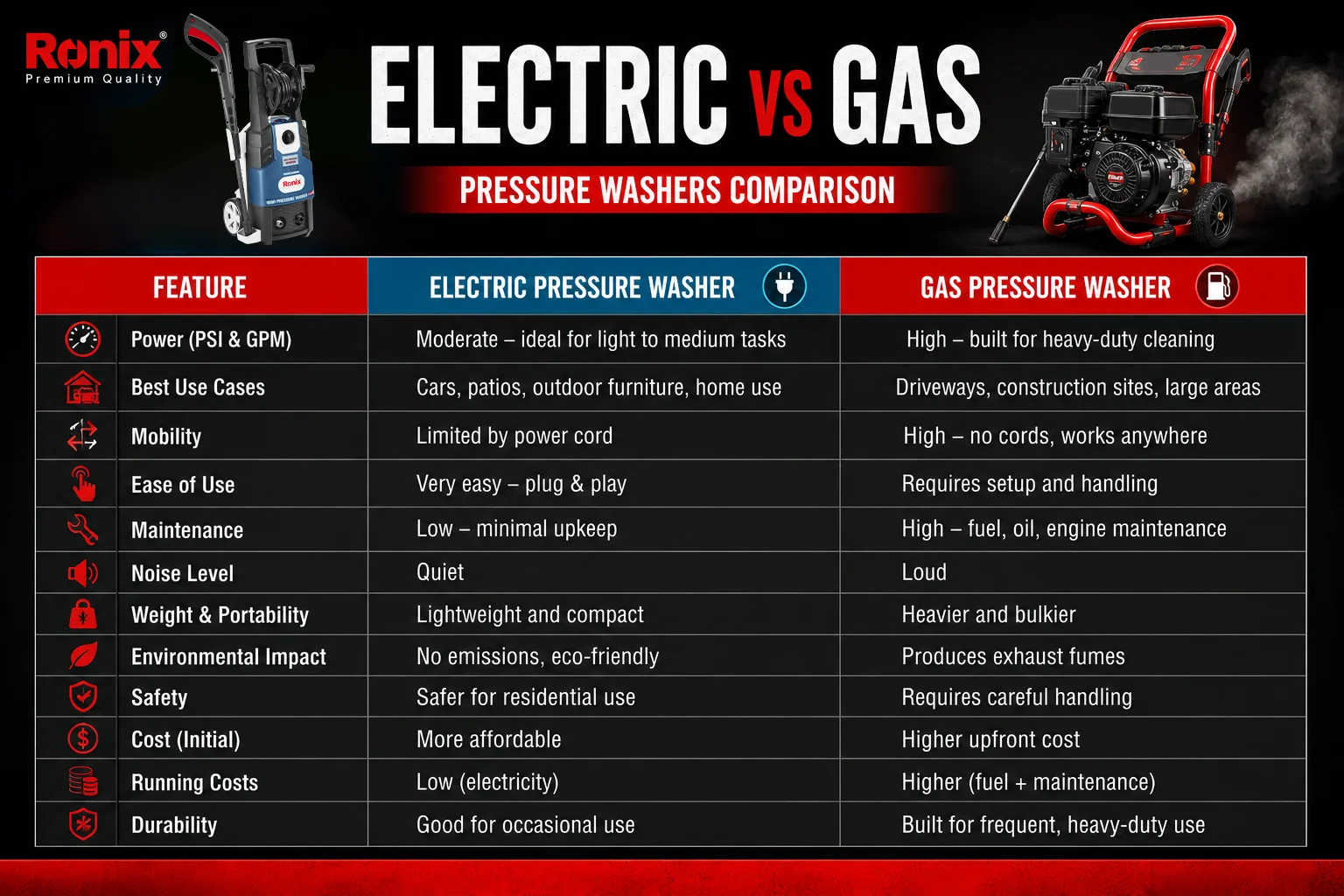
The journey of high-pressure cleaning begins with the power source that drives the entire system. Your choice between gas and electric determines portability, noise levels, and maximum cleaning power.
How Four-Cycle Gas Engines Generate Power
Gas-powered models utilize robust four-cycle engines similar to those found in lawn mowers. These engines run through intake, compression, power, and exhaust strokes to turn a crankshaft. A throttle lever controls engine speed, directly influencing the pressure output of the connected pump.
- Intake: Piston moves down to draw in fuel and air.
- Compression: Piston rises to compress the mixture tightly.
- Power: Spark plug ignition forces the piston down.
- Exhaust: Burnt gases exit through the muffler.
Pro Tip: Always use gasoline with no more than 10% ethanol to prevent moisture attraction and fuel system corrosion.
Why Electric Motors Offer Simplicity
Electric pressure washers rely on motors ranging from 1,500 to 2,000 watts for residential tasks. They plug directly into standard outlets and start instantly with the flip of a switch. These units are quieter and require less maintenance since they lack carburetors and exhaust systems.
- Ideal for patios, cars, and apartment balconies.
- Consistent pressure delivery without manual throttle adjustments.
- Lower maximum PSI compared to gas counterparts.
Warning: Never operate electric models indoors or in wet conditions without Ground Fault Circuit Interrupter protection.
The Pump Mechanism That Creates High Pressure
The pump serves as the heart of the machine where low-pressure water becomes a cleaning weapon. Engine power transfers directly to this component to initiate the pressurization cycle.
Axial Cam and Triplex Plunger Designs
Two primary pump designs dominate the market based on durability needs. Axial cam pumps are affordable and lightweight, making them suitable for occasional home use. Triplex plunger pumps employ three plungers moving in sequence for smoother operation and professional longevity.
- Axial Cam: Cost-effective for light duty tasks.
- Triplex Plunger: Built for daily commercial use and efficiency.
The Suction and Discharge Cycle
Water pressurization happens through a rapid sequence of upward and downward strokes within the pump chamber. During the upward stroke, the plunger lifts to create a vacuum that opens the input check valve. The downward stroke forces the input valve closed and pushes water out through the output valve.
- Plunger lifts to create suction and draw water in.
- Input valve closes as plunger pushes down.
- Output valve opens to discharge high-pressure water.
- Cycle repeats hundreds of times per minute.
Critical Note: Never run the pump without water supply as this causes instant overheating and seal failure.
Water Flow Path From Inlet to Outlet
Pressurized water travels through a specialized path engineered to withstand extreme internal forces. Each component in this chain plays a vital role in maintaining safety and performance.
Inlet Filter Protection
Water enters the system through a standard garden hose connection but first passes through a mesh filter. This critical barrier traps sand, rust, and debris before they can damage internal valves or scratch pump seals.
- Prevents abrasive particles from entering the pump.
- Ensures consistent water flow rates.
- Requires regular cleaning to maintain pressure.
Maintenance Must: Clean the inlet filter after every few uses to prevent flow restriction and pressure loss.
Reinforced High-Pressure Hoses
The hose connecting the pump to the wand is far superior to a standard garden hose. It features multiple layers of rubber, wire braid, and polymer to withstand over 200 bars of pressure. Typical burst pressure ratings sit at three to five times the operating pressure for safety.
- Standard inner diameter is 1/4 inch.
- Lengths usually range from 25 to 50 feet.
- Shorter hoses experience less pressure drop.
Safety Check: Inspect hoses regularly for bulges, cracks, or leaks and replace damaged units immediately.
Unloader Valves and Thermal Safety Systems
Safety mechanisms protect the machine when you stop spraying but the engine keeps running. These components manage pressure spikes and heat buildup to prevent catastrophic failure.
Unloader Valve Recirculation Function
Releasing the trigger gun stops water flow but does not stop the pump immediately. The unloader valve detects the resulting pressure spike and redirects water back to the inlet side. This recirculation allows the engine to run safely without building dangerous pressure levels.
- Detects pressure increases when trigger is released.
- Redirects flow to the inlet for recirculation.
- Prevents hose bursting and pump stress.
How to Test: If pressure drops significantly when pulling the trigger, the unloader valve may be stuck or worn.
Thermal Release Valve Operation
Friction from recirculating water generates heat that can damage the pump over time. A thermal release valve opens automatically when water temperature reaches approximately 140°F. It discharges hot water and allows cool water to enter the system.
- Activates at critical temperature thresholds.
- Prevents seal deformation and pump damage.
- Signals the need to shut down if cycling continuously.
Warning: If the thermal valve discharges frequently, reduce idle time to let the machine cool.
Nozzle Spray Angles and Cleaning Intensity

Nozzles control the spray pattern and intensity of the water stream hitting your surface. Choosing the correct color-coded nozzle is essential for effective cleaning without causing damage.
| Color | Angle | Best Use | Risk Level |
|---|---|---|---|
| Red | 0° | Deep stains, concrete | High |
| Yellow | 15° | Driveways, grease | Medium |
| Green | 25° | Decks, cars, general | Low |
| White | 40° | Windows, rinsing | Minimal |
| Black | Wide | Detergent application | None |
How Nozzle Orifices Focus Energy
A tiny orifice in the nozzle forces water into a focused stream to maximize velocity. Internal baffles shape the water into specific angles for different cleaning tasks. Smaller holes create higher velocity and more aggressive cleaning action.
- Red nozzles concentrate all force into one point.
- White nozzles spread water for gentle rinsing.
- Black nozzles create low pressure for soap application.
Pro Tip: Always test on a hidden area first and start with the Green 25-degree nozzle for safety.
Detergent Injection Using the Venturi Effect
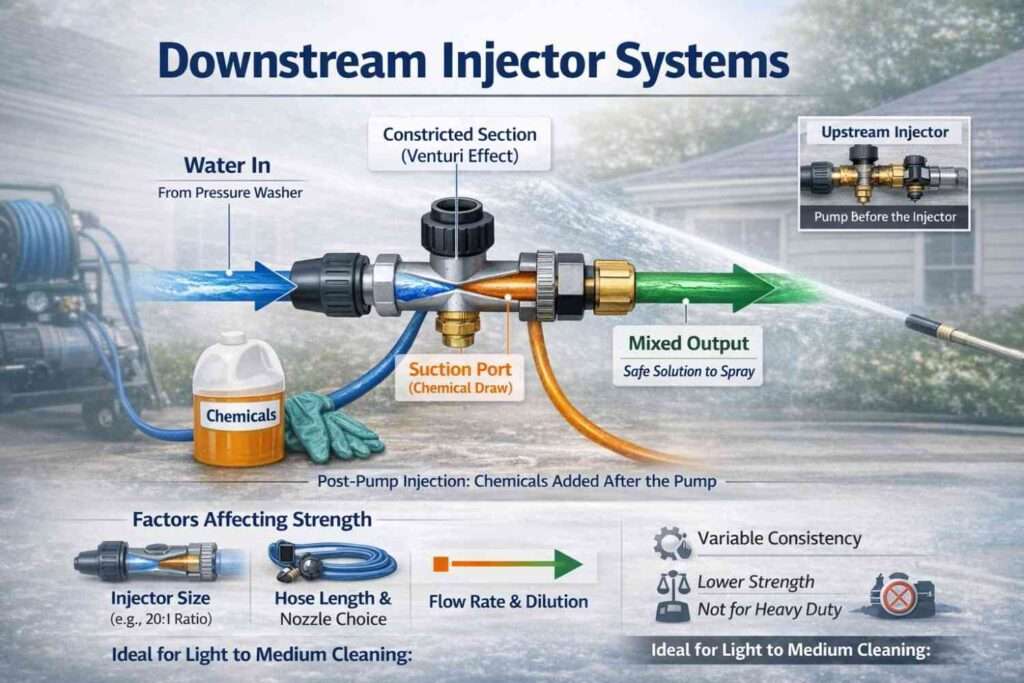
Chemical injection systems allow you to apply cleaning solutions for tough oil or organic stains. Most units use a passive system based on the Venturi effect rather than a separate chemical pump.
Passive Soap Suction Mechanism
High-speed water flowing through a constriction creates an area of low pressure. This suction draws detergent from a reservoir into the water stream automatically. The mixture combines in the line before exiting the nozzle.
- Requires a low-pressure black nozzle to function.
- High pressure would blow chemical back into the tank.
- Mixes soap and water without moving parts.
Proper Detergent Application Steps
Applying detergent correctly ensures maximum cleaning power while protecting your equipment. Follow these steps for optimal results on greasy or heavily soiled surfaces.
- Switch to the black low-pressure nozzle.
- Spray detergent evenly over the surface.
- Let the solution dwell for 3 to 5 minutes.
- Switch to a green or yellow nozzle to rinse.
Note: Some professional models feature positive pressure injectors for stronger chemical mixing capabilities.
Water Efficiency Compared to Garden Hoses

Pressure washers offer significant environmental and economic advantages through water conservation. They achieve superior cleaning results while using a fraction of the water required by traditional methods.
Consumption Rate Comparison
A standard garden hose consumes between 3,000 and 5,000 liters of water per hour. In contrast, a pressure washer uses only 400 to 500 liters per hour to achieve better results. This represents a water usage reduction of up to 80 percent.
- Garden Hose: 3,000–5,000 liters per hour.
- Pressure Washer: 400–500 liters per hour.
- Savings: Up to 80% less water waste.
Eco Tip: Use plain water whenever possible since many jobs do not require chemical additives.
Troubleshooting Low Pressure and Leaks
Even well-maintained machines can encounter issues that reduce performance. Understanding common problems helps you diagnose and fix them quickly.
Diagnosing Air in the Pump
Air pockets are the most common cause of low or no pressure because air compresses while water does not. This disrupts the hydraulic flow needed to generate force. Running the machine with the trigger released for 10 to 15 seconds often purges trapped air.
- Ensure water supply is fully open.
- Check and clean the inlet filter.
- Run machine with trigger released to bleed air.
Quick Test: Remove the nozzle and pull the trigger. Strong flow indicates a clogged nozzle rather than a pump issue.
Addressing Leaks and Seal Failures
Leaks usually indicate worn O-rings, seals, or loose fittings within the system. Tighten connections by hand followed by a quarter turn with a wrench. Replace cracked hoses or worn seals immediately to prevent further damage.
- Worn O-rings require replacement during maintenance.
- Loose fittings should be tightened carefully.
- Cracked hoses must be replaced for safety.
Use pump saver during storage to keep internal seals lubricated and prevent cracking.
Safety Protocols for High-Pressure Operation
Operating a pressure washer requires strict adherence to safety guidelines to prevent injury. The stream can penetrate skin or strip paint in seconds if misused.
Essential Personal Protective Equipment
Flying debris and chemical splashbacks pose serious risks to operators. Always wear safety goggles to protect your eyes from projectiles. Closed-toe shoes protect your feet from high-pressure streams and falling tools.
- Safety goggles prevent eye injuries.
- Closed-toe shoes protect feet from spray.
- Gloves improve grip and shield hands from chemicals.
Never point the wand at people, pets, or yourself even when using a wide nozzle.
Surface Damage Prevention
Using the wrong nozzle can cause irreversible damage to delicate surfaces. Soft materials like painted wood or vinyl siding require wide-angle nozzles to prevent etching. Always start with the widest angle and move narrower only if necessary.
- Use white or green nozzles for soft surfaces.
- Test yellow or red nozzles on inconspicuous areas.
- Avoid zero-degree nozzles on vehicles or wood.
Golden Rule: Start wide and move narrow only if the surface can handle increased intensity.
Frequently Asked Questions About Pressure Washers
How much more pressure does a pressure washer generate than a hose?
A pressure washer boosts water pressure from standard 2–3 bars up to 200 bars or more. This creates a force up to 50 times greater than a standard garden hose for deep cleaning.
Why does my pressure washer lose pressure when I pull the trigger?
This issue often indicates a stuck or worn unloader valve that fails to regulate pressure correctly. It can also signal air in the pump or a clogged inlet filter restricting water flow.
Can I use hot water in a standard pressure washer?
No, standard pressure washers are designed for cold water only unless specifically labeled as hot-water models. Using hot water can damage seals and internal components not rated for high temperatures.
How often should I change the oil in my pressure washer pump?
Triplex plunger pumps require regular oil changes similar to car engines, typically every 50 to 100 hours of use. Axial cam pumps often have sealed units that do not require oil changes.
What causes a pressure washer pump to overheat?
Overheating usually results from running the machine with the trigger released for too long without recirculation. A malfunctioning thermal release valve or blocked water supply can also cause excessive heat buildup.
Key Takeaways for Understanding How a Pressure Washer Works
Mastering how does a pressure washer work empowers you to clean more effectively while extending the life of your machine. You now know that high-velocity water removes dirt through kinetic energy rather than brute force alone. Proper nozzle selection and routine maintenance are just as important as the engine power itself.
Apply this knowledge to choose the right settings for every surface you encounter. Regular checks of filters, seals, and fuel quality will keep your unit running smoothly for years. Start your next cleaning project with confidence and precision.